
Treadmill flat rate pricing is a fixed fee charged for a specific repair service, covering labor costs regardless of how long the job takes. This pricing model gives homeowners and gym operators a predictable repair cost before any technician touches the machine. Understanding treadmill flat rate pricing explained in full detail helps you budget repairs, avoid surprise bills, and decide when a fix makes more financial sense than a replacement. Texastreadmillrepair uses this model across South Texas, and the difference it makes for clients managing repair decisions is significant.
What is treadmill flat rate pricing and how does it work?
Flat rate pricing in treadmill repair means you pay a set fee for a defined service, not an hourly charge that grows with every complication. The technician quotes a price for the specific repair before work begins. That price holds whether the job takes 45 minutes or two hours.
Flat rate pricing provides financial transparency and protects customers from escalating hourly bills caused by unforeseen complications. That protection matters most when a repair involves disassembly, motor access, or console diagnostics where labor time is hard to predict.
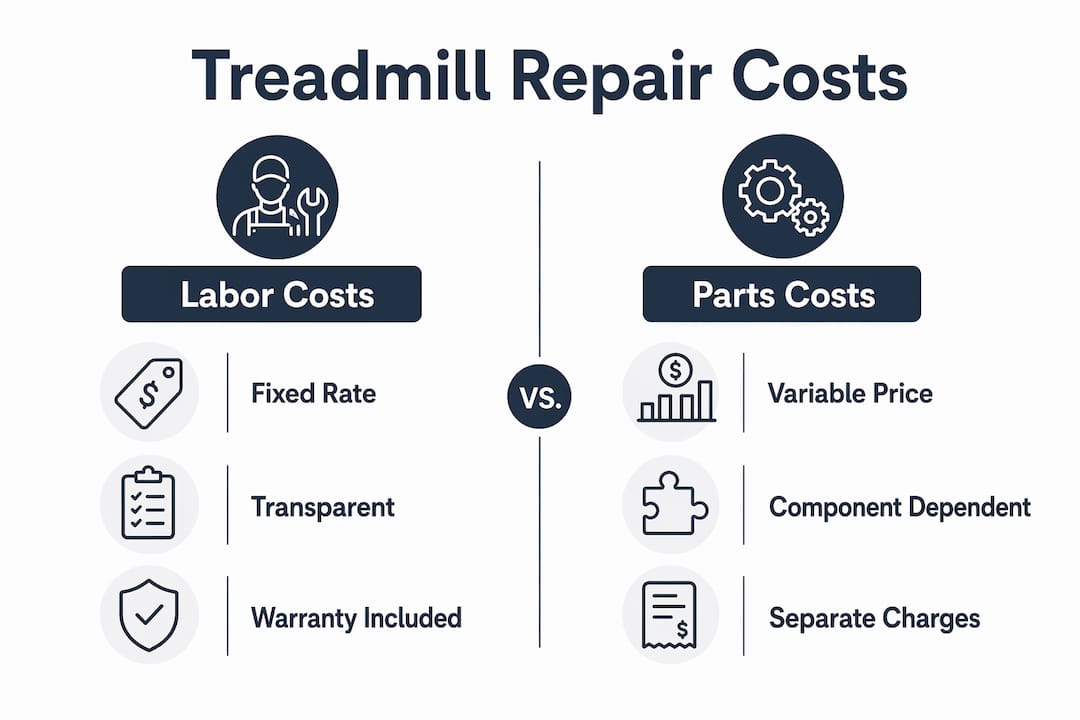
The flat rate typically covers labor only. Parts are priced separately and vary widely depending on the component and treadmill brand. A complete quote should always itemize labor and parts as separate line items. Never assume parts are bundled unless the provider confirms it in writing.
Diagnostic or service call fees are a separate charge from the flat rate labor fee. These diagnostic fees typically run $75–$150 and cover the technician's initial assessment and travel. Many providers credit the diagnostic fee toward the final repair cost if you proceed. Confirm this policy before the technician arrives.
Warranty terms vary by provider. Reputable repair providers commonly offer warranties from 90 up to 180 days on parts and labor, with some extending to one year. Texastreadmillrepair includes a 90-day warranty on all parts and labor as a standard term. A multi-treadmill service contract can extend coverage further for gym owners managing multiple machines.
Pro Tip: Ask every provider to send a written quote that separates labor, parts, diagnostic fees, and any travel surcharges before you confirm the appointment. A verbal flat rate quote without itemization is not a complete quote.
What do common treadmill repairs cost under flat rate pricing?
Average treadmill repair costs range between $150 and $400 depending on the complexity of the issue. That range covers labor. Parts add to the total based on the specific component replaced.
The table below shows typical flat rate cost brackets for the most common treadmill repairs in 2026.
| Component | Typical Parts Cost | Notes |
|---|---|---|
| Drive belt | $100–$200 | Common wear item, straightforward replacement |
| Walking belt | $200–$350 | Labor intensive, deck condition affects total cost |
| Motor controller board | $200–$450 | Diagnostic required to confirm board failure |
| Drive motor | $300–$600+ | Highest cost repair; replacement vs. rewind decision applies |
Drive belt and walking belt replacements are the most frequent repairs. They are also the most predictable under flat rate pricing because the labor scope is well defined. Motor controller board and drive motor repairs carry more variability because diagnosis takes longer and parts sourcing depends on the treadmill brand.
A motor controller board replacement on a NordicTrack or ProForm home treadmill costs less to source than the same repair on a Life Fitness or Precor commercial unit. The labor flat rate may be identical, but the parts cost difference is significant. Always get a full parts-plus-labor quote, not just the labor flat rate.
Pro Tip: If your treadmill shows an error code before the technician arrives, write it down. Error codes speed up diagnosis and can reduce the diagnostic fee if the fault is already identified. Learn more about reading treadmill error codes before your appointment.
How does location and treadmill type affect flat rate costs?
Geography changes the real cost of a flat rate repair more than most owners expect. Travel surcharges of 20–30% above base labor are common in high-cost metro areas or for service calls exceeding 30 miles from the technician's base. A $200 flat rate labor quote in a rural area can become $240–$260 in a dense urban market.
Several factors drive pricing differences across locations and machine types:
- Urban labor markets. Cities with higher costs of living pay higher technician wages. Those costs pass through to flat rate labor fees.
- Service radius limits. Providers often charge a travel fee for calls beyond 25–30 miles. Confirm the radius before booking.
- Commercial vs. residential machines. Commercial treadmills from Life Fitness and Precor have easier to source parts compared to many home models, which can lower total repair costs over the machine's lifetime.
- Brand-specific parts availability. Older or discontinued home treadmill models may require sourced or third-party parts, which increases both cost and repair time.
- Gym owner volume. Gym operators managing five or more machines often negotiate lower flat rate labor fees through service contracts. Individual homeowners pay standard retail rates.
Gym owners face a different cost structure than residential users. A single repair on a commercial treadmill may cost more upfront, but the parts ecosystem for brands like Life Fitness and Precor makes long-term maintenance more cost-effective. Home treadmill owners often face the opposite situation: lower upfront repair costs but harder-to-find parts as machines age.
Flat rate vs. hourly pricing: which model works better for you?
The core difference between flat rate and hourly pricing is where the financial risk sits. Under hourly pricing, the risk sits with you. Under flat rate pricing, it sits with the technician.
| Factor | Flat rate pricing | Hourly pricing |
|---|---|---|
| Cost predictability | Fixed before work begins | Varies with labor time |
| Budget control | High | Low to moderate |
| Risk of surprise costs | Minimal | High if complications arise |
| Best for | Defined, common repairs | Short, simple diagnostics |
| Transparency | Clear upfront | Depends on technician efficiency |
Hourly pricing can work in your favor for very short, simple jobs where the technician resolves the issue in under 30 minutes. A loose console connection or a belt tension adjustment may cost less under hourly billing. For anything involving disassembly, parts replacement, or motor work, flat rate pricing protects your budget.
The most important step with either model is clarifying terms before work starts. Ask whether the diagnostic fee applies toward the repair. Ask whether parts are included or billed separately. Ask whether travel is part of the flat rate or added on top. These three questions eliminate the majority of billing disputes.
Pro Tip: Get competing quotes from two providers using the same repair description. If one quotes flat rate and one quotes hourly, ask the hourly provider for a not-to-exceed cap. That converts hourly pricing into a de facto flat rate and gives you a fair comparison.
When should you repair vs. replace your treadmill?
The repair-versus-replace decision has a clear financial guideline. If repair costs exceed 50% of a comparable replacement machine's value, replacement is usually the better financial choice. Apply this rule before approving any repair quote.
Follow these steps to make the decision clearly:
- Get a full repair quote. Include labor, parts, diagnostic fees, and travel. Use the total, not just the flat rate labor figure.
- Research the replacement cost. Find the current price for a comparable new or refurbished model. Check the repairable vs. unrepairable signs guide to assess your machine's condition objectively.
- Apply the 50% rule. If the total repair quote exceeds half the replacement cost, the math favors replacement.
- Consider refurbished commercial options. A refurbished Life Fitness 95T typically costs $3,500–$4,500 compared to $10,000+ new, with 7–12 years of useful life remaining and a warranty included. For gym owners, this is often the best value path.
- Factor in warranty coverage. New and refurbished units come with manufacturer warranties. A repaired machine carries only the technician's 90-day or 180-day warranty. For high-use commercial environments, that difference matters.
Gym owners should also weigh downtime costs. A commercial treadmill out of service loses revenue every day it sits idle. In that context, a higher repair cost may still be justified if it gets the machine running within 48 hours versus waiting weeks for a replacement delivery.
Key Takeaways
Flat rate treadmill pricing gives you cost certainty before work begins, but the total bill always includes parts, diagnostic fees, and travel on top of the base labor rate.
| Point | Details |
|---|---|
| Flat rate covers labor only | Always request a separate parts quote to get the true total repair cost. |
| Diagnostic fees are often credited | Confirm the provider credits the $75–$150 fee toward repair before booking. |
| Location affects total cost | Travel surcharges of 20–30% apply in high-cost or long-distance service areas. |
| Use the 50% rule for replacement | Replace rather than repair when the total quote exceeds half the machine's replacement value. |
| Warranty terms vary | Standard coverage runs 90–180 days; confirm terms in writing before approving work. |
What most treadmill owners get wrong about flat rate pricing
Most people hear "flat rate" and assume the quote they receive is the final number. That assumption costs money. The flat rate is the labor fee. Parts, diagnostic charges, and travel are almost always separate line items, and they can double the total bill on a complex repair.
The mistake I see most often is owners approving a repair based on a verbal flat rate quote without asking about parts. A $175 flat rate labor fee sounds reasonable until a $320 motor controller board gets added to the invoice. The total was always going to be $495. The owner just did not know it yet.
For gym owners managing multiple machines, this problem compounds fast. One unverified quote across five treadmills can mean thousands of dollars in unexpected costs. A service contract with itemized flat rate terms for each repair type is the only way to budget maintenance accurately at scale.
The other thing most owners miss is the diagnostic fee credit. Many providers credit the $75–$150 diagnostic fee toward the repair total if you proceed. That effectively makes the diagnostic free. But you have to ask. Providers rarely volunteer this information upfront.
My advice is simple: before any technician arrives, get a written quote that lists labor, parts, diagnostic fee, and travel as separate line items. If a provider cannot give you that, find one who can. Pricing clarity is not a luxury. It is the minimum standard for a trustworthy repair service.
— Steve
Get transparent flat rate service from Texastreadmillrepair
Texastreadmillrepair serves homeowners and gym operators across South Texas with same-week appointments and certified technicians who come directly to your location. Every repair is quoted with flat rate labor, itemized parts, and no hidden travel fees within the service area.

Texastreadmillrepair includes a 90-day warranty on all parts and labor as a standard term on every job. Not sure whether your machine is worth repairing? The owner's repair guide walks you through the decision before you spend a dollar. Ready to book a service visit or get a quote? Visit the treadmill repair services page to get started.
FAQ
What does flat rate treadmill pricing actually include?
Flat rate pricing covers the labor fee for a specific repair, charged as a fixed amount regardless of time spent. Parts, diagnostic fees, and travel surcharges are typically billed separately and should be confirmed before work begins.
How much does a typical treadmill repair cost under flat rate pricing?
Average treadmill repair costs range from $150 to $400 for labor, with parts adding $100 to $600 or more depending on the component. A full quote including parts and diagnostic fees gives you the accurate total.
Is the diagnostic fee included in the flat rate?
The diagnostic fee, typically $75–$150, is usually a separate charge that covers the technician's initial assessment and travel. Many providers credit this fee toward the final repair cost if you proceed with the service.
When is it better to replace a treadmill than repair it?
Replace rather than repair when the total repair quote exceeds 50% of the cost of a comparable replacement machine. Refurbished commercial treadmills from brands like Life Fitness offer strong value at 60–70% below new pricing.
Do flat rate prices differ for commercial and home treadmills?
Yes. Commercial treadmills from brands like Life Fitness and Precor have more readily available parts, which can lower total repair costs over time. Home treadmill repairs may carry higher parts costs for older or discontinued models despite similar flat rate labor fees.