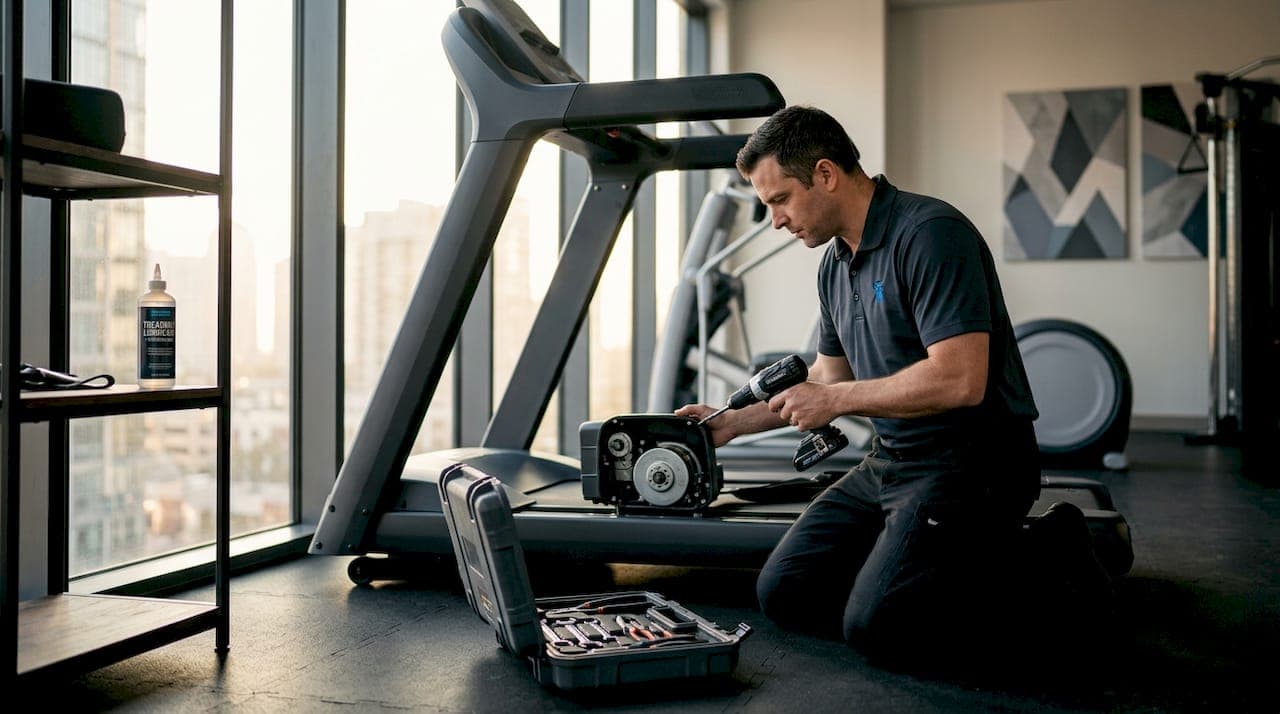
Treadmill power fluctuation causes fall into three distinct categories: mechanical wear, electrical instability, and static electricity discharge. When your treadmill surges, slows, or hesitates mid-run, the fault traces back to belt tension problems, a failing motor control board, an unstable power outlet, or electrostatic buildup attacking the console. Brands like Matrix and Star Trac build in speed sensors and optical encoders that amplify any underlying fault into a visible speed inconsistency. Stryd even recommends indoor mode to suppress elevation sensor noise that creates artificial power spikes on indoor treadmills. Diagnosing the right category first saves you from replacing the wrong part.
What mechanical factors commonly cause treadmill power fluctuations?
Mechanical problems are the most frequent source of treadmill speed inconsistency, and most of them are visible or audible before they become serious. The three main culprits are belt tension, deck friction, and motor brush wear.
Belt tension and deck friction
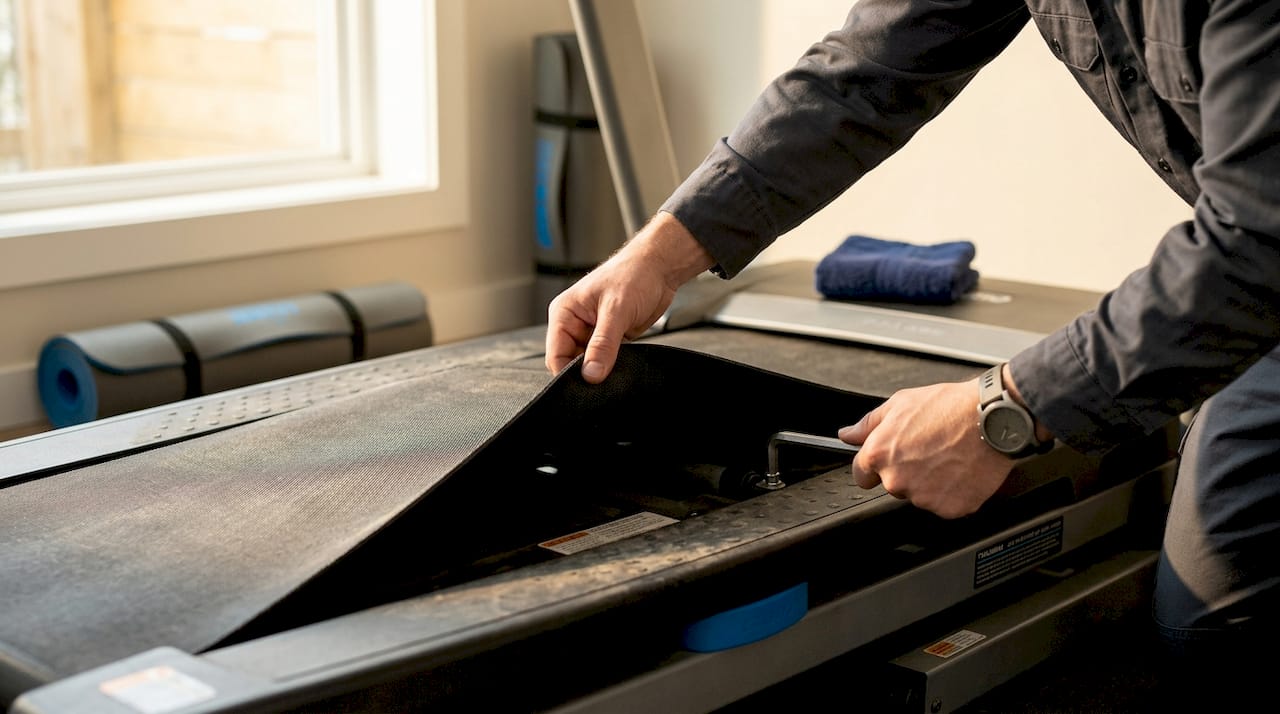
A loose belt slips under your foot strike, forcing the motor to compensate with a sudden burst of power. That compensation is what you feel as a surge or hesitation. Dry decks and loose belts increase motor load and commonly cause speed drops under body weight. The fix is straightforward: tighten the rear roller bolts a quarter turn at a time until the belt holds firm without slipping, then apply silicone lubricant between the belt and deck every three months.
Deck friction compounds the problem. When the deck surface wears down or dries out, the belt drags instead of gliding. The motor draws more current to maintain the set speed, and the control board struggles to keep up. You will notice the hesitation most at 3 to 5 mph, where body weight impact is highest relative to belt speed.
Worn motor brushes and speed sensors
Worn motor brushes reduce torque output gradually, so the motor cannot hold speed under load. The symptom is a treadmill that runs fine at low speeds but bogs down or surges above 6 mph. Misaligned or dirty optical encoders send erratic speed feedback to the control board, which then over-corrects and creates the fluctuation you feel. Cleaning the encoder wheel with a dry cloth and realigning the sensor bracket often resolves this without any part replacement.
Common mechanical symptoms to watch for:
- Grinding or squeaking noise under the belt during use
- Speed hesitation only when you step onto the belt
- Belt that slides sideways toward one edge of the deck
- Motor that smells hot after short sessions
- Console speed readout that jumps erratically while the belt feels smooth
Pro Tip: To check belt tension safely, turn the treadmill off and lift the center of the belt from the side. It should lift two to three inches. More than that means it is too loose; less means it is too tight and will overstrain the motor.
How do electrical issues affect treadmill power stability?
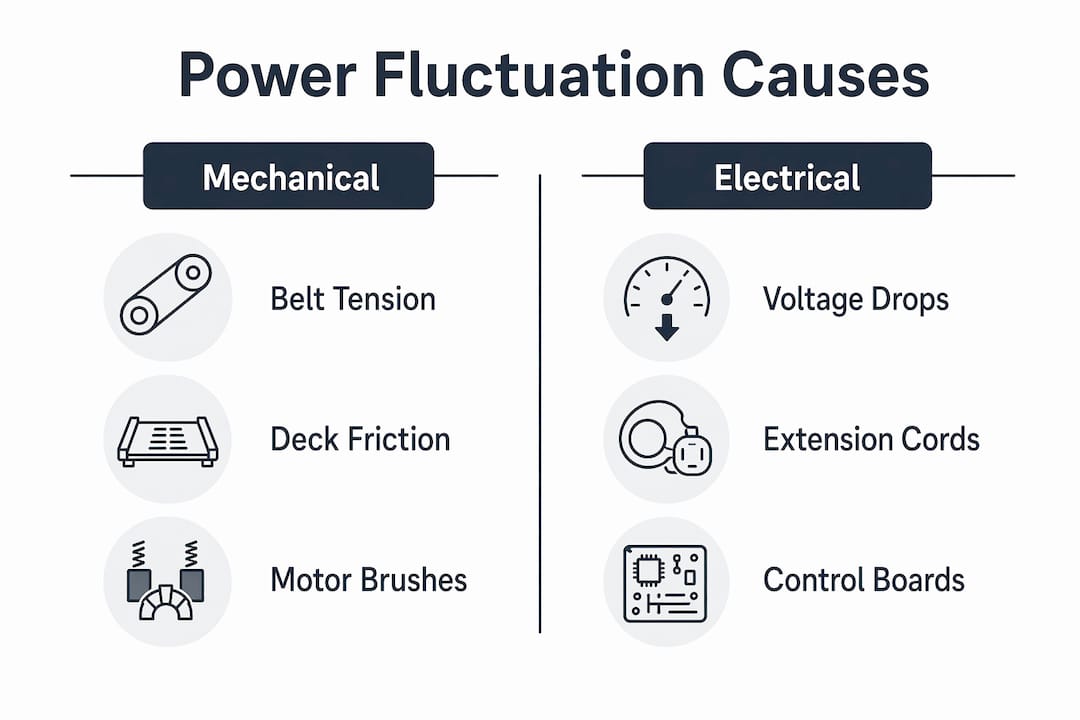
Electrical supply quality significantly affects treadmill performance, and low voltage or unstable outlets frequently mimic mechanical failures. This is why checking your power source before touching any mechanical component is the smarter first move.
Brownouts, circuit overloads, and extension cords
Brownouts cause temporary drops in supply voltage that disrupt treadmill control boards, producing erratic motor speeds or unexpected startups. A brownout can last seconds or hours depending on grid demand, and your treadmill's control board interprets the voltage drop as a command signal rather than a supply fault. The result is a machine that starts on its own or surges without input.
Typical household circuits support 1,800 to 2,400 watts. A treadmill running at full load alongside a space heater or air conditioner can push that circuit past its limit, tripping the breaker mid-workout. That is not a treadmill fault. It is a circuit management problem, and the fix is dedicating a 20-amp circuit to the treadmill alone.
Extension cords are a separate risk. Undersized extension cords heat up under treadmill current draw and create voltage drop at the motor, causing speed surges or slowdowns as the machine struggles to maintain load. If you must use an extension cord, it must be a heavy-duty, UL-listed cord rated for at least 15 amps with a 14-gauge or thicker wire. Most standard household extension cords are 16-gauge and will cause problems.
Failing motor control boards
Control boards degrade over time from heat and component wear, producing erratic motor control especially at higher speeds. A failing board delivers inconsistent voltage to the motor, which shows up as surges, sudden slowdowns, or complete shutoffs above 7 mph. Console flickering during speed changes is a reliable early warning sign.
Electrical symptoms that point away from mechanical causes:
- Console display dims or flickers when the motor accelerates
- Treadmill trips the breaker at startup rather than under load
- Speed surges occur even with no one on the belt
- Machine shuts off completely then restarts without input
- Burning smell near the motor housing with no belt friction noise
How can static electricity cause apparent treadmill power problems?
Static electricity is a commonly overlooked cause of treadmill console issues that replacing power components will never fix. This matters because users in dry climates or during winter months often misdiagnose ESD damage as a control board failure.
Friction between the moving belt and the deck generates a static charge that accumulates on the user's body. When you touch the metal handrails or console frame, that charge discharges through the console electronics. The console freezes, becomes unresponsive, or resets entirely while the motor keeps running. The treadmill appears to have a power problem, but the motor and control board are functioning normally.
Electrostatic discharge can cause irreparable damage to delicate console electronics, requiring full replacement rather than repair. Prevention is the only real solution once the damage is done.
Dry environments accelerate static buildup. South Texas winters are mild but indoor heating drops humidity significantly, creating the same conditions as a northern winter. Running on synthetic flooring without a treadmill mat compounds the charge accumulation.
Pro Tip: Place a rubber-backed treadmill mat under the machine, keep indoor humidity above 40%, and apply silicone lubricant to the deck regularly. Lubrication reduces belt friction, which directly reduces the static charge generated per stride.
Symptoms that suggest ESD rather than a power supply fault:
- Console freezes or resets only when you touch the handrails
- Problem worsens in winter or after the heater runs
- Motor and belt continue operating normally during the console freeze
- Shock sensation when touching metal parts of the frame
What troubleshooting steps help identify the root cause?
Distinguishing whether fluctuations happen only under load or at all times is the single most effective way to separate mechanical wear from electrical instability. Follow this sequence before calling a technician or ordering parts.
-
Check the power source first. Plug the treadmill directly into a dedicated grounded wall outlet. Remove any extension cord. If the fluctuation disappears, the cord was the problem. If it persists, move to step two.
-
Inspect belt tension and lubrication. Turn the machine off and lift the belt from the side. Check for the two-to-three inch lift range. Apply silicone lubricant if the deck feels dry or rough to the touch. Run the treadmill unloaded and observe whether the speed holds steady.
-
Observe when the fluctuation occurs. If it only happens when you step on the belt, the cause is mechanical: belt tension, deck friction, or motor brush wear. If it happens with no one on the belt, the cause is electrical: control board, power supply, or circuit instability.
-
Test on an isolated circuit. Avoiding extension cords and shared circuits is a critical first step that often avoids unnecessary component replacements. If the treadmill shares a circuit with other appliances, move it to a dedicated outlet and retest.
-
Check for static symptoms. Run the treadmill and touch the handrail deliberately. If the console resets or freezes at that moment, ESD is the cause. Add a treadmill mat and increase room humidity before running again.
-
Contact a certified technician if the fluctuation persists after steps one through five. A failing motor control board or worn motor brushes require professional diagnosis and part replacement. Continuing to run the machine risks treadmill hidden damage that escalates repair costs significantly.
Preventive maintenance to avoid treadmill power fluctuations
Regular maintenance including lubrication and proper belt tension significantly reduces mechanical causes of power fluctuation and slows component wear. These habits cost almost nothing and prevent the most common repair calls.
Maintenance practices that protect your treadmill:
- Lubricate the deck every 90 days with 100% silicone lubricant. Never use WD-40 or petroleum-based products, which degrade belt material.
- Check belt tension monthly. A belt that loosens gradually is the most common cause of speed inconsistency in home treadmills.
- Use a surge protector rated for treadmill use, not a standard power strip. Surge protectors absorb voltage spikes that would otherwise reach the control board.
- Plug into a dedicated 20-amp outlet. Shared circuits cause the majority of electrical fluctuation complaints that look like treadmill faults.
- Keep room humidity between 40% and 60% to limit static charge buildup, especially during winter months when heating systems dry the air.
- Schedule a professional inspection annually. Motor brushes, control boards, and deck surfaces wear at rates that are difficult to assess visually. A certified technician catches degradation before it becomes a failure. If your machine runs hot before it fluctuates, review the treadmill overheating reasons that often precede motor and board failures.
Key takeaways
Treadmill power fluctuations trace back to belt tension, electrical supply quality, motor control board wear, or static discharge, and identifying which category applies determines the correct fix.
| Point | Details |
|---|---|
| Mechanical causes first | Loose belts and dry decks are the most common source of speed inconsistency and are fixed with tension adjustment and lubrication. |
| Electrical supply matters | Dedicated grounded outlets and no extension cords eliminate the majority of voltage-related fluctuation complaints. |
| Static electricity is real | Console freezes caused by ESD require prevention through mats, humidity control, and lubrication, not component replacement. |
| Observe the pattern | Fluctuations only under load point to mechanical wear; fluctuations at idle or startup point to electrical or board failure. |
| Maintenance prevents repairs | Monthly belt checks and quarterly lubrication reduce the risk of power fluctuation and extend machine life significantly. |
What I've learned diagnosing treadmill power problems in South Texas
The most common mistake I see is users replacing the motor control board when the real problem is a 16-gauge extension cord running to a shared circuit. The board gets blamed because it is the most visible electrical component, but the fault is upstream. I have seen this exact misdiagnosis cost people $200 to $400 in unnecessary parts.
The second pattern I notice is that static electricity problems spike in January and February in South Texas. People run their heaters, indoor humidity drops, and suddenly consoles start freezing. They call thinking the console died. In most cases, a treadmill mat and a small humidifier resolve it completely without touching a single component.
My honest recommendation: always start with the power outlet and the belt before assuming any component has failed. The mechanical and electrical basics account for roughly 80% of the fluctuation complaints I diagnose. The remaining 20% involve genuine board or motor failures, and those are easy to confirm once you have ruled out the basics. Skipping the fundamentals wastes time and money every single time.
— Steve
When to call Texas Treadmill Repair for power fluctuation issues
If you have worked through the troubleshooting steps and your treadmill still surges, hesitates, or shuts down unexpectedly, the problem is likely a worn motor control board, degraded motor brushes, or a deck that needs replacement. These repairs require certified diagnosis and proper parts.

Texastreadmillrepair serves home and gym clients across South Texas with same-week appointments and flat-rate pricing. Certified technicians come directly to your location in Mission, Corpus Christi, and McAllen, so you never need to transport your machine. Every repair includes a 90-day warranty on parts and labor. Browse the full list of treadmill repair services to see exactly what is covered before you book.
FAQ
What is the most common cause of treadmill speed fluctuation?
A loose or dry belt is the most common cause. Increasing friction between the belt and deck forces the motor to work harder, producing speed drops or surges, especially when body weight loads the belt.
Can a bad outlet cause my treadmill to fluctuate?
Yes. Brownouts, shared circuits, and undersized extension cords all create voltage instability that disrupts the motor control board and produces erratic speed behavior.
How do I know if static electricity is causing my treadmill console to freeze?
If the console freezes or resets specifically when you touch the handrails, and the motor continues running normally, electrostatic discharge is the cause. The problem typically worsens in dry winter conditions.
Should I use an extension cord with my treadmill?
No. Treadmills require a dedicated grounded outlet. If an extension cord is unavoidable, use a heavy-duty UL-listed cord rated for at least 15 amps with 14-gauge wire or thicker.
When does a treadmill power fluctuation require professional repair?
If fluctuations persist after checking belt tension, lubricating the deck, and confirming a clean dedicated power source, the motor brushes or control board likely need professional inspection and replacement.